A View of Planet Earth With Summer - Page 3
 |
 |
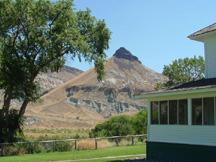 |
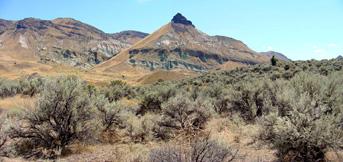
We next headed for the Sheep Rock Unit of the John Day Fossil Beds National Monument. This is where the Park Headquarters is located, about 50 miles south of Fossil, Oregon. This unit is named for the prominent peak in the area, which got it's name from the wild bighorn sheep that settlers saw roaming it's sides. Later, sheep ranching became the primary occupation here as it did in a good portion of north central Oregon. In fact, the actual park headquarters is located in an old ranch house (the James Cant Ranch, built in 1917), which is now beautifully maintained by the park service and contains a small museum for visitors. This ranch once had over 4,000 sheep, but now it caters to many visitors who venture into this remote but beautiful country. We took advantage of the inviting front yard and green grass of the ranch house by having a picnic lunch at a table that was parked near a shade tree.We then took a walk behind the house to where a trail led a quarter mile down to the banks of the John Day River. Along the trail were interpretive signs that explained the farm history and the riparian nature of the area.
 |
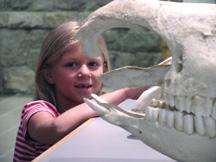 |
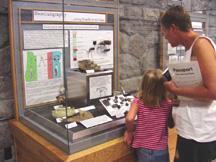
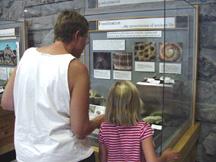
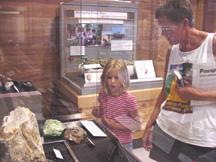
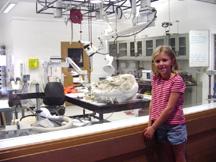
Across the road from the Cant Ranch is the new Thomas Condon Paleontology Center, an interpretive and research facility, which is truly a fascinating place. It serves as the visitor center for the park and has a fossil museum, theatre, education classroom, bookstore, visitor facilities, and a professional paleontology laboratory. Visitors can watch through a large glass window as scientists and technicians work to preserve and restore fossils (some of the over 40,000 they have in current inventory).
We first went into the theatre where we watched a movie about the park. We learned about how the geologic events in this region turned it into a place where scientists now have a rare view of paleontological history that is unequalled in North America; where they can study a time period of some 50 million years that occurred after dinosaurs and before humans walked the earth. This visitor and research center was named after the man who first recognized the significance of this area back in 1865 when he first made a visit. He later became Oregon's first state geologist in 1872 while teaching geology as a university professor. Earlier, he was a minister and served as a pastor in St. Helens, Forest Grove, Albany, and The Dalles, Oregon where he established a Congregational Church in 1862. Condon, Oregon, which we had passed through earlier, when we saw the giant windmills, was actually named for his nephew who was an attorney.
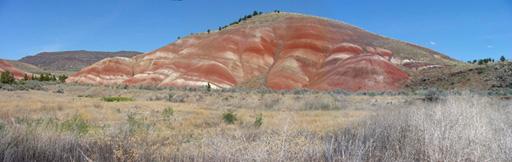
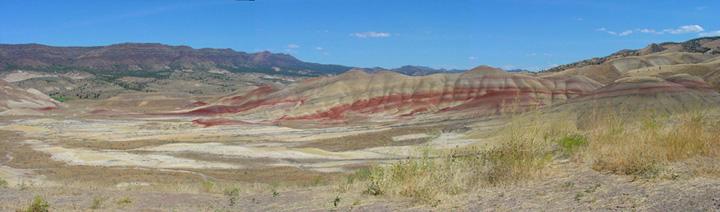
After learning all we could (in the time we had) at the Sheep Rock Unit, it was time to move on to the Painted Hills Unit, which is about 35 miles to the west. This unique area is totally different than the other two units of the Monument and its beauty struck us. The smooth undulating rolling hills are mostly void of vegetation and are streaked with beautiful bands of color. The hills are remnants of the Lower John Day Formation and are mostly composed of claystone, most of which is decomposed volcanic ash, which periodically showered down over millions of years on floodplain areas to depths of over 1,000 feet. Layering of the claystone can be seen in the vividly hued bands of red, pink, ocher, and black that are caused by various leached out oxides of metals. Interesting blotches of black (oxides of manganese) are seen in places where it occurs in pockets of specific strata and then bleeds downhill from rainfall.